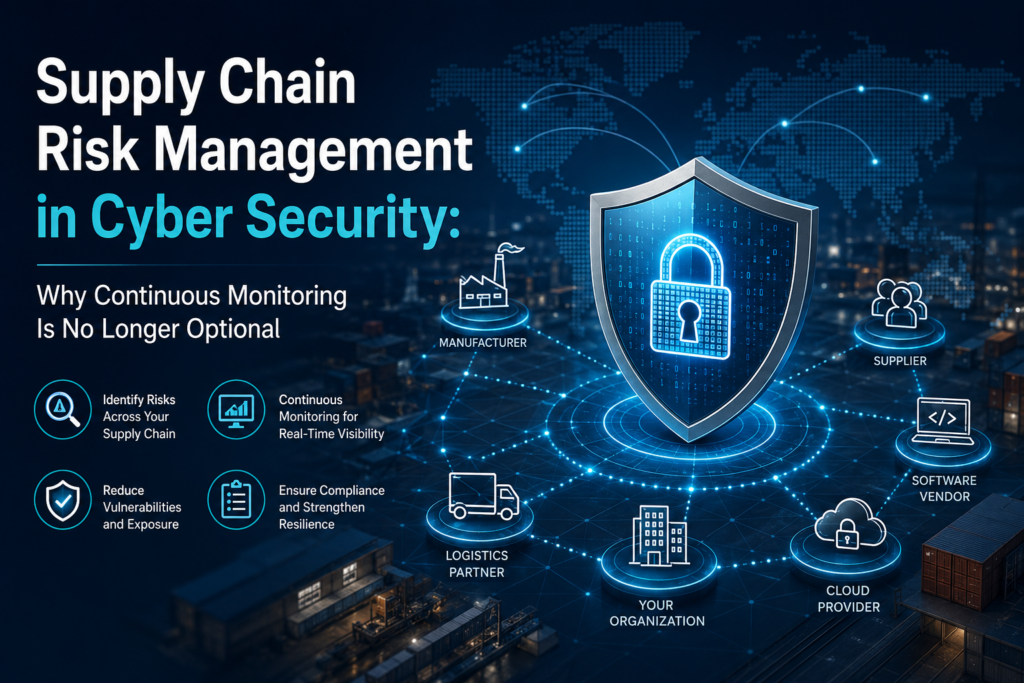
Every organization today runs on a network of vendors, software providers, cloud platforms, and third party tools. This connected ecosystem drives efficiency, but it also creates a wide attack surface that traditional security controls were never built to cover. This is where supply chain risk management in cyber security becomes critical. It is the practice of identifying, assessing, and reducing the risks that vendors, partners, and software dependencies bring into an organization’s environment.
In this blog, we break down what supply chain risk management really means, why supply chain monitoring has become a board level priority, and how businesses can build a stronger, more resilient security posture.
What Is Supply Chain Risk Management in Cyber Security?
Supply chain risk management, often called SCRM, is a structured approach to identifying vulnerabilities across the entire vendor and technology ecosystem an organization depends on. This includes software vendors, hardware suppliers, cloud service providers, open source components, and outsourced IT partners.
A single weak link, such as an unpatched vendor system or a compromised software update, can expose an entire organization to data breaches, ransomware, or operational shutdowns. High profile incidents in recent years have shown that attackers increasingly prefer to target smaller vendors as an entry point into larger, better defended organizations.
Why Supply Chain Attacks Are Increasing
Organizations rely on hundreds of third party vendors, each with different security maturity levels.
Open source and third party code libraries are widely used but rarely monitored continuously.
Attackers find it easier to breach a smaller supplier than a well protected enterprise.
Cloud adoption has expanded the number of integration points and API connections.
Regulatory bodies now expect proof of vendor risk oversight, not just internal security controls.
Core Components of an Effective Supply Chain Risk Management Program
1. Vendor Risk Assessment
Before onboarding any vendor, organizations need visibility into that vendor’s security practices, certifications, and past incident history. This includes reviewing security questionnaires, compliance status, and data handling practices.
2. Continuous Supply Chain Monitoring
A one time assessment is not enough. Vendor risk changes constantly as new vulnerabilities emerge, credentials leak, or a supplier’s infrastructure changes. Continuous supply chain monitoring tracks vendor risk in real time, flagging exposed credentials, misconfigurations, dark web mentions, and emerging threats connected to your extended ecosystem.
3. Third Party Access Controls
Limiting what vendors and partners can access, applying least privilege principles, and reviewing permissions regularly reduces the blast radius if a partner is compromised.
4. Incident Response Planning for Third Parties
A strong SCRM program includes a clear plan for how the organization will respond if a vendor is breached, including communication protocols, containment steps, and recovery timelines.
5. Compliance and Regulatory Alignment
Frameworks such as NIST, ISO 27001, and various regional data protection laws increasingly require documented supply chain oversight. A mature program keeps this documentation current and audit ready.
The Role of Supply Chain Monitoring in Cyber Security
Supply chain monitoring gives security teams ongoing visibility into the risk posture of every vendor, application, and integration connected to the business. Instead of relying on annual audits, monitoring tools continuously scan for indicators of compromise, exposed assets, leaked credentials, and vulnerabilities tied to third party systems.
This proactive approach allows security teams to detect risk early, prioritize the vendors that need attention, and respond before a small issue becomes a full scale breach. It also strengthens vendor accountability, since suppliers know their security posture is being actively tracked rather than checked once a year.
Best Practices for Building Supply Chain Resilience
- Maintain an updated inventory of all vendors, software, and third party integrations.
- Classify vendors based on the sensitivity of data or systems they can access.
- Use continuous monitoring tools instead of point in time assessments.
- Require vendors to report security incidents within a defined time frame.
- Conduct periodic tabletop exercises that include third party breach scenarios.
- Review and update vendor contracts to include clear security obligations.
How Beyond Cloud Intel Helps
At Beyond Cloud Intel, we help organizations build practical, scalable supply chain risk management programs. Our approach combines continuous monitoring, vendor risk scoring, and actionable threat intelligence, so security teams can focus on the risks that matter most instead of chasing spreadsheets and manual questionnaires.
Whether you are starting your supply chain security program from scratch or looking to modernize an existing process, our team can help you design a framework that fits your industry, regulatory requirements, and risk appetite.
Frequently Asked Questions
What is supply chain risk management in cyber security?
It is the process of identifying, assessing, and mitigating security risks introduced by vendors, suppliers, and third party software used by an organization.
Why is supply chain monitoring important?
It provides continuous visibility into vendor risk, helping organizations detect vulnerabilities, leaked credentials, and emerging threats before they lead to a breach.
How often should vendor risk be assessed?
Vendor risk should be monitored continuously rather than assessed once a year, since new vulnerabilities and threats can appear at any time.
Who needs a supply chain risk management program?
Any organization that relies on external vendors, cloud providers, or third party software, which today includes almost every business, benefits from a structured SCRM program.
Final Thoughts
Supply chain risk management is no longer a compliance checkbox. It is a core part of any organization’s cyber security strategy. As vendor ecosystems grow more complex, continuous supply chain monitoring becomes the most reliable way to stay ahead of threats hiding in third party relationships.
Ready to strengthen your organization’s supply chain security? Request a demo with Beyond Cloud Intel today and see how continuous monitoring can protect your business.