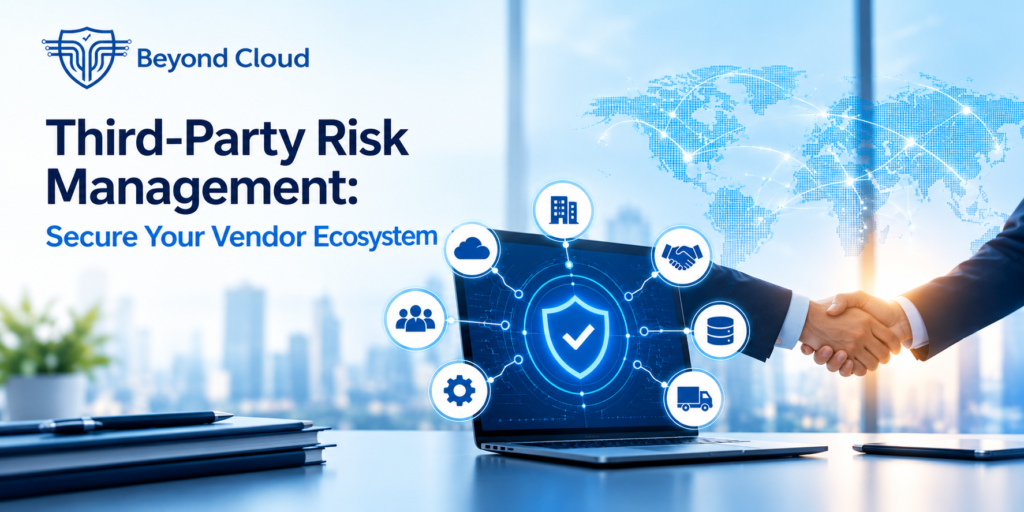
Every modern business runs on other businesses. Cloud providers host your data, SaaS tools run your workflows, payment gateways process your revenue and suppliers keep your operations moving. These partnerships drive speed and innovation, but they also open doors that you do not fully control.
That is why third-party risk management (TPRM) has moved from a compliance checkbox to a core part of cybersecurity strategy. A single vulnerable vendor can expose your customer data, disrupt operations and damage the brand trust you spent years building.
In this guide, we explain what third-party risk management is, why it matters, where most organizations go wrong, and how a continuous, intelligence-driven approach keeps your vendor ecosystem secure.
What Is Third-Party Risk Management?
Third-party risk management is the process of identifying, assessing, monitoring and reducing the security, compliance and operational risks that come from external parties. These include:
- Vendors and suppliers
- Business partners and service providers
- SaaS tools and cloud platforms
- APIs and external integrations
A strong TPRM programme gives you complete visibility into who has access to your systems and data, how secure they really are, and what to do when something changes.
Why Third-Party Risk Is a Growing Cybersecurity Problem
Attackers know that breaking into a well-defended company is hard, while breaking into one of its smaller vendors is often easier. Once inside a vendor, they can reach the larger target through trusted connections. This is the heart of supply chain security risk.
Some of the situations security teams face every day show how quickly vendor risk can turn into business risk:
- A vendor data breach: a CRM provider exposes thousands of your customer records.
- An expired compliance certificate: a cloud provider’s ISO 27001 certification lapses and nobody notices for weeks.
- A security downgrade: a hosting provider’s risk score quietly drops from A to C.
- Fourth-party risk: your vendor’s own sub-processor fails a penetration test.
- Shadow SaaS: a team starts using an unapproved project management tool with company data.
None of these show up in a once-a-year vendor questionnaire. They need continuous visibility.
Why Traditional Vendor Risk Assessments Fall Short
Many organizations still rely on spreadsheets, annual questionnaires and manual reviews. The problems are well known:
- Point-in-time snapshots: a vendor can look compliant in January and be breached by March.
- Hidden dependencies: you cannot protect vendors, integrations and APIs you do not know exist.
- No prioritization: treating every vendor equally wastes effort on low-risk suppliers while critical ones are under-monitored.
- Slow response: manual processes mean threats are found after they have already caused damage.
The Four-Stage Third-Party Risk Management Lifecycle
An effective TPRM programme follows a continuous pipeline rather than a one-time exercise.
1. Discover
You cannot manage what you cannot see. Continuous vendor discovery maps all your vendors, partners and service providers, including hidden or unmanaged dependencies and shadow SaaS.
2. Assess
Each vendor’s security posture is evaluated against your security and compliance standards, from the moment of onboarding and throughout the relationship.
3. Prioritize
Not every risk is equal. Vendor risk scoring ranks threats by severity and business impact, so your team focuses on the critical few instead of drowning in alerts.
4. Mitigate
Actionable recommendations and automated remediation workflows help you close gaps fast, whether that means pushing a vendor to patch, tightening access or revoking credentials.
Key Capabilities to Look for in Third-Party Risk Management Software
When evaluating a TPRM platform, make sure it covers these essentials:
- Continuous vendor discovery: automatic mapping of your entire third-party ecosystem.
- Real-time vendor risk monitoring: instant alerts on breaches, vulnerabilities and posture changes.
- Risk prioritization and insights: data-driven scoring based on severity and business impact.
- Automated risk remediation: workflows that reduce response time and manual effort.
- Third-party visibility and control: deep insight into vendors, APIs and integrations.
- Compliance and vendor reporting: audit-ready reports aligned with industry standards and regulatory requirements.
How Beyond Cloud Helps You Manage Third-Party Risk
Beyond Cloud’s Third-Party Risk Intelligence solution is built to give organizations complete control over their vendor ecosystem. Instead of periodic check-ups, the platform works as a continuous monitoring layer, so you know about vendor risks before they affect your business.
Here is what that looks like in practice:
- 24/7 monitoring of vendors, partners, SaaS tools, APIs and suppliers.
- 500+ vendors assessed with 98% risk coverage and a response time of under two hours.
- A unified dashboard showing vendor risk distribution from low to critical, and tracking risks against those resolved.
- Ready-to-use deliverables: vendor risk alerts, compliance reports, remediation logs and executive briefings.
Because Beyond Cloud combines automation, real-time intelligence and expert-driven insight, security teams get faster detection, smarter prioritization and efficient remediation, without a complex setup. It also connects with the platform’s wider capabilities, including supply chain monitoring, attack surface management and dark web monitoring, so third-party risk is never viewed in isolation.
Best Practices for a Stronger TPRM Programme
- Build and maintain a complete inventory of vendors, including SaaS and integrations.
- Tier your vendors by criticality and the sensitivity of data they handle.
- Run a security assessment before onboarding, not after.
- Monitor continuously instead of relying on annual reviews.
- Track certificate expiry and compliance status automatically.
- Extend visibility to fourth parties and sub-processors.
- Have a clear offboarding process, including revoking vendor access and API credentials.
- Report vendor risk to leadership in clear, business-focused language.
Conclusion
Your security is only as strong as the weakest vendor connected to you. In a world where businesses depend on dozens or even hundreds of external partners, manual and periodic vendor reviews are no longer enough. A proactive, continuous approach to third-party risk management protects your data, your compliance standing and your reputation.
Beyond Cloud helps you discover, assess, prioritize and mitigate third-party risk in one intelligent platform, so you can grow your partnerships with confidence.
Ready to strengthen your third-party risk management?
Get full visibility and control over your vendor ecosystem. Book a free demo with Beyond Cloud or learn more on the Third-Party Risk Management page.